
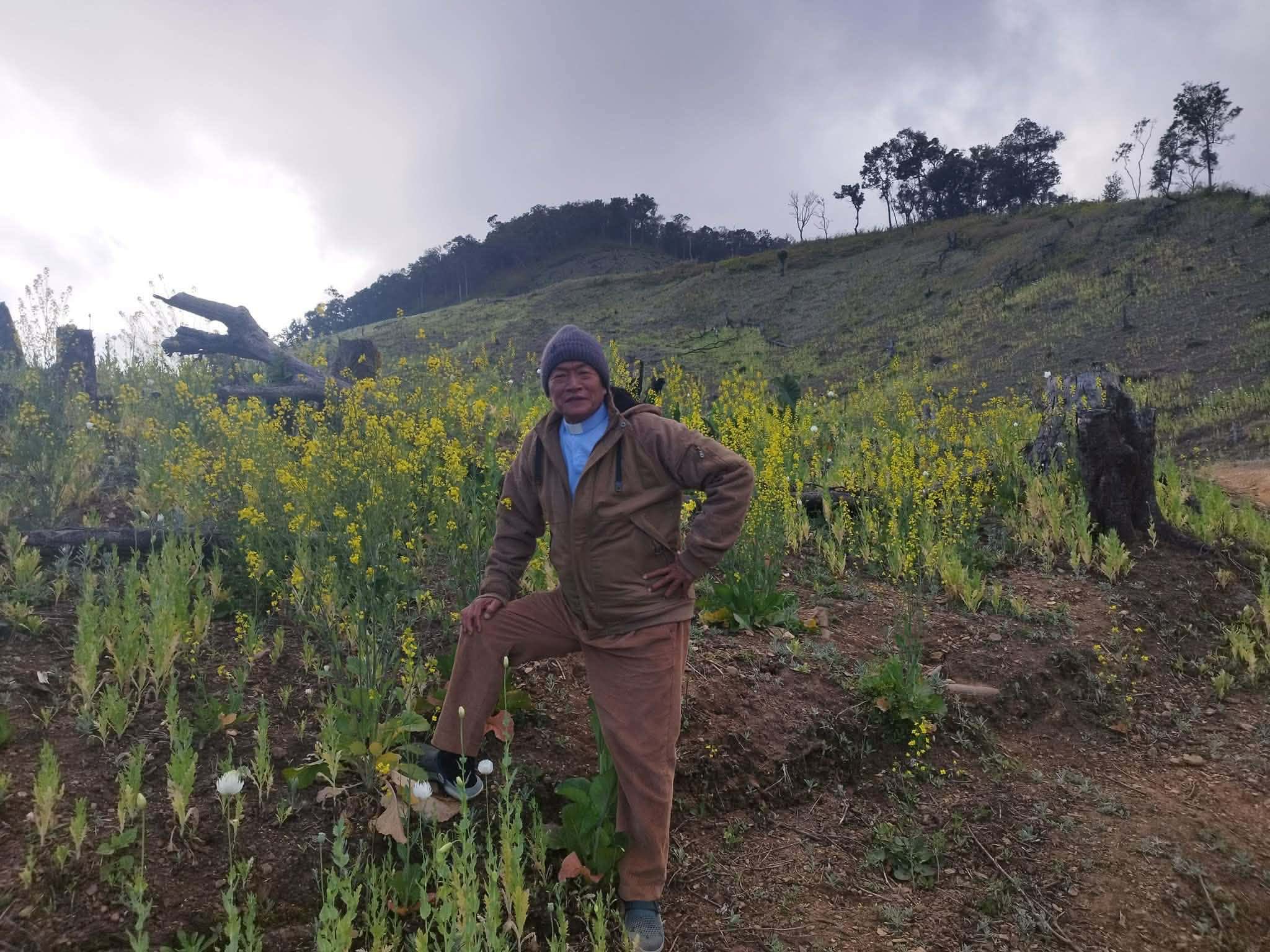
A Catholic missionary group led by Rev. Father Andrew Go Lian, who is still working on the poppy fields in Tonzang Township, Chin State, visited the poppy fields in early January 2026 and led a New Year’s service for parishioners working in the fields. Rev. Father Andrew Go Lian also filmed and photographed the conditions in the poppy fields and posted them on social media, drawing criticism from all sides. The most common criticism was for the church service held on January 5 at a tented church in Suangto village, east of Tonzang Township, where opium farmers live.
Rev. Father Andrew, who has been criticized for his visit, said, “I am not going to the poppy growing areas to encourage poppy cultivation. I am going to the remote areas to preach. I went there because my parishioners are there. My group includes sisters and priests. I also went to the tent church in the middle of the forest because my parishioners are there and we held a service. It is not appropriate for religious organizations and churches to act in a way that encourages poppy growers. We should not interact with them, accept money or donations from their opium trade,” said a local middle-aged man, commenting on the poppy farmers.
Father Andrew said he does not have the authority to do anything about the poppy cultivation in remote areas. He added, “It is my responsibility to take care of the spiritual needs of my members, wherever they are and in whatever situation they are in. I personally went to the poppy fields. I did not exclude the farmers, I led the worship services for them. It is not right to discriminate against my own members. On the other hand, I had to tell them that the government does not accept poppy cultivation, the church does not accept it, and the community rejects it, and I do not accept it either.”
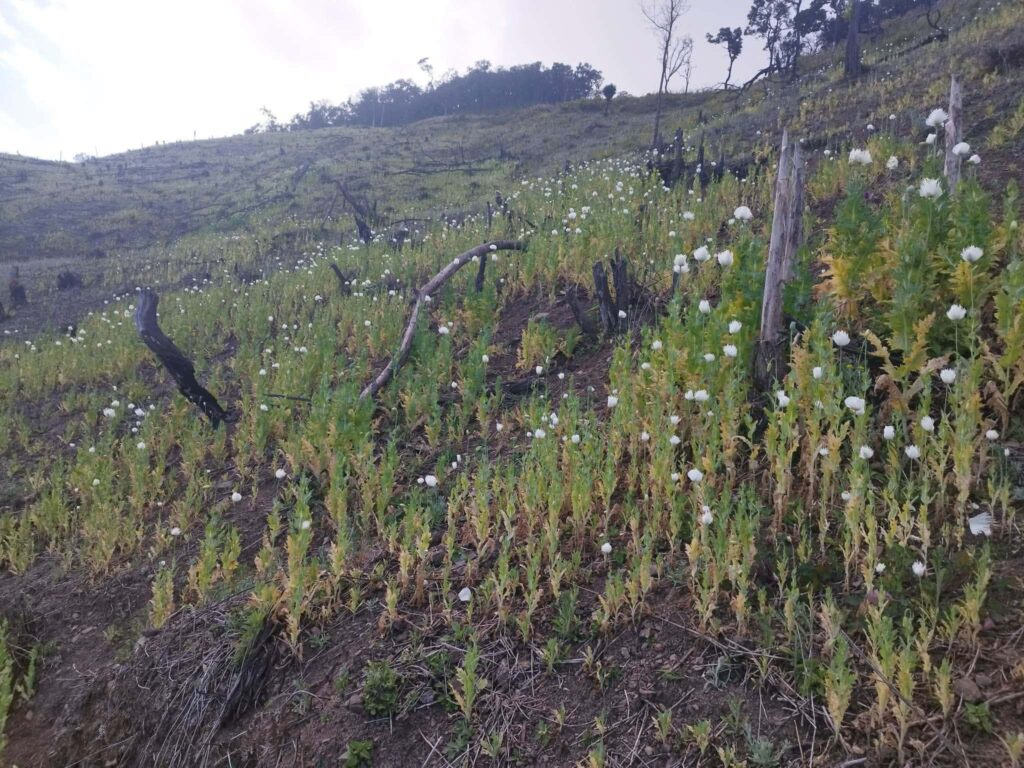
Describing the situation in the area, Father Andrew said, “We have Skat trucks full of daily wage workers coming from the plains to work in the opium fields in the forest. They earn about 20,000 Myanmar kyats a day. The hills are full of opium fields as far as the eye can see. They don’t feel guilty. They seem to be living a normal life. It will be difficult for adults to escape this cycle of opium cultivation. I have urged them to think ahead and plan for the next generation to escape this mire.”
Regarding Father Andrew’s personal visits to the opium poppy cultivation areas, a young local activist said, “Father Andrew Go Lian has no business dealings with the opium poppy fields. He went there to interact with the farmers as a religious duty. He used to visit the opium poppy fields regularly during the New Year period. He was able to do things that we regular socio-political activists could not do. His records are the information that shows us the true situation of the area.”
The United Nations Office on Drugs and Crime (UNODC), which has been researching and monitoring opium poppy cultivation in Myanmar, has not yet conducted field measurements in Chin State, but has instead calculated the area based on VHR (Very High Resolution) satellite images. “The price of raw opium this year is uncertain. It is currently the season for extracting opium. There is not much buying like last year. We are even worried about not getting a good price,” said a young man who has contact with opium farmers.
The United Nations Office on Drugs and Crime (UNODC) estimates that Chin State will have 831 (806-858) hectares of opium cultivation in 2024, and 1,040 (1,000-1,090) hectares of opium cultivation in 2025, indicating that opium cultivation in Chin State will increase by 26% in 2025 compared to 2024.
Hits: 9